Starborn : Version #260
The Realms of Sky exist, but they are not like the game we know. The game is merely a muddy reflection of a fragment of the journey of a single Starborn, filtered through the dreams and imagination of the game devs. They got some things right… but many things, they got entirely wrong. Chief among them being the nature of the Starborn.
Starborn ageless, sexless celestial beings that can be compared to a fallen star. They are also known as Starchildren, Lightborn, Skykids, and Children of Light.
They are my take on the Skykid, or player character, in the game Sky: Children of the Light.
Basic Information Hide
Starborn are celestial beings that can be compared to a fallen star. They are also known as Starchildren, Lightborn, Skykids, and Children of Light. They are ageless celestial beings whose bodies are vessels for an inner light, with a core in their chest. Although small and youthful in appearance, they are not human children, and their anatomy retains adult proportions. Their existence follows a cycle of formation, gathering light, exploration, and the eventual journey to Eden. Survival through that cycle is not guaranteed. While a Starborn can get into Orbit, and to a unique portal through which they can be reborn, they were broken in a fundamental level when they fell. They are no longer able to ascend fully and are trapped in an eternal cycle of death and rebirth until they die fully.
Lore and History Hide
-Coming Soon
Social Habits and Temperament Show
Starborn are naturally social, curious, playful, and often mischievous. They gravitate toward one another, enjoy physical closeness, carry one another, and enjoy being carried. They have no concept of personal space and no taboo around touch. They have no cultural expectation that playfulness must be abandoned with age, and no stigma attached to remaining playful. Older Starborn tend to become calmer and more collected over time, but they do not lose their curiosity or enjoyment of games.
A newly formed Starborn will instinctively seek out another with more marks. A Starborn with more marks is older and more experienced and can serve as a guide.
Starfire Shrines are important gathering places, sources of light, and destinations for returning Starborn. Major shrines have access to the sky, while smaller shrines provide safe places along journeys. A dead shrine can be reignited with a winged light, though this requires a Starborn to give up one of theirs. Often, older Starborn with plenty of winged light will do this. Some resemble large bonfires. The portal network is something that still survives from the seyren civilization that once thrived in the Realms. Aviary Village has one of the greater shrines, and is a safe area Starborn often stop to rest. Many spirits who are tethered to the Realms somehow remain at the village where they interact with the Starborn who visit. It contains a portal nexus. The most powerful Starfire shrine known is simply referred to as “Home”. Most older Starborn return here when they complete the cycle. Home is said to be where the Elders first descended.
While Starborn don’t really have a sense of property, they do often claim little nooks and crannies in seyren ruins as a nest, a place they gather anything interesting they find, a place to rest and recover. Most bring Starfire lanterns there to make it somewhere they can recover and rest. They tend to nest around central shrines, in places where many other Starborn gather.
They are not equipped with the anatomy necessary for spoken language, although they produce distinctive calls, chirps, squeaks, squawks, and other vocal expressions, all sounding musical and resonant. Calls work together with posture, ear movements, and tail movements as communication. Individuals recognize one another through their calls and energy signatures; personal names are not their default means of identification.
Starborn can acquire language through memory sharing. They can understand spoken language and learn to read and write without becoming capable of speech.
Memory sharing is fundamental to their nature. They share memories with one another and encounter the memories of spirits. Those experiences can affect their appearance, and they can learn to reproduce structures observed in a memory. A copied feature does not necessarily come with an understanding of its purpose or all its functions. Memories can therefore contribute both to knowledge and to physical changes in a vessel.
Anatomy and Physiology Show
The Seyren were mortal flesh-and-blood beings with cores of light. They had faces beneath their masks, and wearing masks carried substantial cultural importance. They did not fly or gather scattered light as Starborn do. Starborn bodies loosely follow the seyren template. Seyren are extinct, but their spirits and memories remain, and encounters with spirits can grant a Starborn permanent strength.
They have a warm, clay-like surface and are much sturdier than their delicate appearance suggests. They lack conventional biological organs and do not need food or air. They have no biological reproductive system. Their bodies are extremely light, approximately comparable in weight to a cat. A strong wind may require them to brace against it, while a harsh gust can knock one right off their feet.
Starborn average around 3 feet tall, and they usually form around this size though this can vary. Their broader size range is approximately one and a half to three and a half feet, with the smallest chibi forms around one foot five inches. Older individuals can learn to control their vessel size, and temporary size-changing items also exist. No embers are chibi-sized: a chibi is an older Starborn using an acquired ability or item. Size therefore does not reliably indicate age, experience, or power.
They are small and slender, and can sometimes be mistaken as a child at a glance. Closer look, though, reveals a small non-human creature.
The tail is used for expression and is neither prehensile nor a counterweight. It cannot grip objects or support the body. Its movements communicate interest, satisfaction, mischief, distress, and other emotional states alongside ear position and posture.
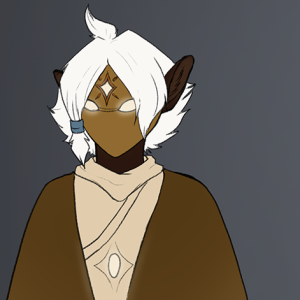
Their mask is basically their face. Starborn have no face beneath the mask and no mouth. They can mimic eating by placing condensed light against their mask where a mouth would be. They simply absorb the light, and the "food" disappears.
Flight comes from the cape acting as wings. The first mark grants one powered flap and enables gliding. Marks on the back of their cape represents their available capacity, and further Winged Light increases that capacity. The first three marks each require one Winged Light, while later wedges require progressively more. The maximum is fifteen marks, though additional Winged Light can be gathered as a buffer beyond that maximum. Flight energy recharges over time, and Starborn can recharge one another through their calls or close proximity. Fifteen-marked individuals are extremely rare.
Light is their nourishment. They absorb light motes rather than eating. They are incapable of eating. They can mimic eating by placing condensed light against their mask, but it’s just a mimickry of the action.
Their reserves affect how much strain they can withstand, including the course of injury and illness. A powerful Starborn with more marks has substantially more capacity than a newly awakened ember, although a large reserve does not make them immune to being hurt or becoming sick.
Starborn do not bleed. Instead, damage leaves their clay-like skin scuffed or cracked, and dark crystals can develop around the injury. The skin also becomes stiff and hard, losing its flexibility until it heals. Illness or depletion can make their colors muted or grey, their eyes and inner light dim, and their movements slow, heavy, and unsteady. They may become lethargic, shiver, curl up, lower their ears, and hold their tails close against their bodies. Thin, quiet, plaintive calls communicate their misery and need for comfort.
Darkness can accumulate within an injured or ill Starborn and seep as black fluid from behind the mask. The fluid is unpleasant, deep, clammy cold. It has been described as viscous and oily or tar-like in appearance, but not sticky, and without an odor. An affected Starborn may repeatedly wipe at the mask because the seepage is uncomfortable.
If it builds up too much, they may expel this darkness through violent surges of inner light. The process superficially resembles vomiting, but there is no stomach, mouth, or muscular digestive mechanism involved. The light itself forces the darkness out from the position where a mouth would be if they had one. They are loosely based off of the bodies of the seyren who once inhabited their world. When feeling ill, they will react similarly to somebody who is nauseated. They won’t want to move much because they are weak and exhausted. They will often curl, shiver, hunch over, and sometimes let out a miserable little call. Right before it happens, their ears will pin back against the sides of their head, their tail will curl tightly against their side, they’ll press their hands against their chest core, often let out a distressed call because they feel downright awful, followed by a sudden brightening or surging of the energy within them. This forces the darkness out of where a mouth would be if they had one, with their light flashing a bit brighter, then going dim with each surge. It appears to materialize just in front of the mask and is projected outward and away from the body. It will burn away readily from a light source.
Reserve capacity changes the pattern of these episodes. A one-marked ember has very little capacity and has more frequent episodes with less material. An older Starborn with more flight power can remain in the earlier shivering and seeping stage considerably longer, and it does not always turn into expulsion if they are strong enough to burn away the darkness with their inner light before it advances too much. If it does happen to an older Starborn, it is generally more forceful, but occurs less frequently. Strength can delay obvious deterioration, and an experienced Starborn may conceal injuries while prioritizing a vulnerable companion.
After the darkness is expelled and no longer growing, the Starborn will generally spend a couple days recovering around a light source.
Mortality is very high among Starborn. Many die before they reach 9 marks on their cape. Starborn with twelve or more marks have lower mortality, but remain vulnerable. A major predator is known as a krill, also called dark dragons. They feed on light and will actively hunt Starborn for their winged light. Their behavior after feeding is animal-like, in that they will stop hunting and rest for a time. Dark crabs are also a common predator. Most Starborn can avoid crab attacks, but weaker, more fragile embers can be killed, especially since dark crabs travel in groups.
Reproduction and Life Cycle Show
Starborn are sexless beings and do not reproduce. They entirely lack any sexual anatomy or reproductive drive. They have no concept of courtship or pair bonding.
A Starborn starts as a falling star, striking the ground with a loud, resonant, musical ringing, almost bell-like. They initially appear lying down in a curled position. They will lay there for a few moments, before they get up, stumble, and orient themselves. At this stage they are confused and a bit skittish. Curious, but cautious. They have white hair, a golden brown mask, and a simple cream tunic, but no cape. They have a strong instinct to seek out the closest winged light. When they find and absorb their first winged light, their new cape is golden brown outside and cream within.
Not all falling stars become a Starborn. There are many that fail. This can appear in a few ways. One, the star goes out before it hits the ground. Two, the star hits with a resonant ring, but when the light clears, nothing is there. Third, a partially formed Starborn can be seen, a silhouette of light, but that fades away leaving nothing behind. All of the unique living light from these failed formations ends up somewhere else as a winged light.
Many of them die before they even gain their wings, and many more die when they are still embers, but those that survive gather enough lost fragments to increase their own power and live longer and hold off the darkness longer. The more wing power a Starborn has, the more likely they are to survive.
Starborn have three distinct life stages.
A newly formed Starborn, who has not yet gone through rebirth, is called an Ember. Embers are new and inexperienced. They are known to be very curious, a bit skittish, and afraid to go too far from sources of light. They cling to light, or other Starborn. Embers start with a single mark, but gain more over time. They tend to go towards Eden when they reach 8 or 9 marks. An Ember is as close to infancy as a Starborn can be, though they do not physically age. They gain experience rather than growing.
Once a Starborn has made it through a rebirth cycle, they become known as an Ascendant. Ascendants usually have at least 8 marks.
Once a Starborn reaches their 12th mark, they are called an Elder. Not to be confused with the temple Elders, who are not the same kind of being as Starborn; they are referred to as the Ancestors. Elder Starborn usually gain their 12th mark around 150 years old. Those who have reached 15 marks are very rare, but are at least 250 years old. They have no known lifespan, but many perish before reaching that point. Elders serve as guides and help embers and younger ascendants survive their trips through Eden’s rebirth cycle. An Ember or Ascendant who has an Elder by their side is much more likely to survive.
All Starborn are drawn toward Eden, but only those who reach the summit return through rebirth. Not every journey ends in a return. Experienced Starborn can guide and shield embers along the way, and an ember who survives a first journey can continue to receive that guidance on later journeys. Returning individuals can be recognizable while having fewer flight wedges; an ember may return with only one. Veterans can control their descent toward shrines. Returning stars may form complete vessels, incomplete vessels that do not survive, or only a glow.
Mutations and Variations Hide
Starborn can control how they appear, so their appearance can vary widely. Their clothing is actually a part of their vessel, though they can appear without it if they really want to. They can modify the shape of their ears, tail, mask, body, height, clothing, cape... they do all have the same basic body plan, but they vary widely between that. They tend to change fluidly based on the memories they have encountered during their life and will stick with looks they enjoy.
Rarely, a Starborn does not have the ability to absorb their first winged light. They remain capeless throughout their existence. They have a simmer glow compared to normal Starchildren and cannot fly, but are surprisingly resilient. Dark creatures generally ignore them, although they can still be struck and must recover from injuries. They can still guide spirits to the threshold, but cannot complete the usual cycle. They can not gather light to take back to the Source.
Other Information Hide
-Coming Soon